Bringing It Back Home: How Precision Fabrication Shops Are Powering America's Manufacturing Renaissance
Photo: Unknown authorUnknown author or not provided, Public domain, via Wikimedia Commons
The Offshore Experiment and Its Unintended Consequences
For roughly three decades, the prevailing logic in American manufacturing was straightforward: labor is cheaper abroad, so production should follow. Corporations shifted operations to Southeast Asia, China, and Mexico in pursuit of lower per-unit costs, and for a time, the math appeared to work in their favor. Profit margins widened, and consumer prices stayed competitive.
Then reality intervened.
The COVID-19 pandemic exposed catastrophic vulnerabilities in globally distributed supply chains. Ports jammed. Container ships sat idle for weeks. Lead times that had once stretched from four to eight weeks ballooned into six-month ordeals — or longer. Manufacturers who had built their production schedules around overseas suppliers found themselves unable to fulfill domestic orders, losing contracts and, in some cases, entire customer relationships.
That disruption accelerated a trend that had already been quietly building: reshoring. According to the Reshoring Initiative, tens of thousands of manufacturing jobs have returned to the United States since 2010, with the pace of that return increasing sharply after 2020. And at the center of this industrial homecoming are precision custom fabrication shops — businesses with the equipment, expertise, and flexibility to meet complex production demands on American soil.
What Is Driving the Reshoring Decision?
The decision to reshore is rarely made on a single factor. It is typically the result of a careful analysis across several dimensions, each of which has shifted meaningfully in recent years.
Total Cost of Ownership Has Narrowed
For years, the offshore cost advantage was framed primarily in terms of labor. What that framing obscured were the ancillary costs: international freight, customs duties, inventory carrying costs, quality inspection overhead, and the expense of managing time-zone-separated supplier relationships. As wages in countries like China have risen substantially and ocean freight rates have remained volatile, the gap between offshore and domestic production costs has narrowed considerably for many product categories.
When manufacturers conduct a true total-cost-of-ownership analysis — one that accounts for logistics, quality escapes, and the capital tied up in transit inventory — domestic fabrication often emerges as more competitive than the initial quote comparison would suggest.
Supply Chain Resilience Has Become a Strategic Priority
Procurement professionals have spent the past several years rethinking risk tolerance. Single-source overseas suppliers, once viewed as cost-efficient, are now recognized as single points of failure. Domestic fabrication shops offer a fundamentally different risk profile: shorter lead times, easier communication, and the ability to respond rapidly when production requirements change.
For industries with tight delivery windows — defense, aerospace, energy infrastructure, and commercial construction — that responsiveness is not a luxury. It is a competitive necessity.
Quality Control Is More Reliable Domestically
Custom metal fabrication is a precision discipline. Tolerances measured in thousandths of an inch matter. Weld integrity matters. Material certifications matter. When production occurs domestically, quality oversight is far more tractable. Engineers can visit a shop floor. Inspectors can conduct in-process audits. Problems can be identified and corrected before they propagate through an entire production run.
Overseas quality issues, by contrast, often surface only after parts arrive — at which point remediation is expensive, time-consuming, and disruptive to downstream schedules.
The Role of Custom Fabrication Shops in the Reshoring Equation
Large-scale contract manufacturers and OEMs frequently capture the headlines when reshoring announcements are made. But the unsung infrastructure enabling those announcements is the network of custom fabrication shops operating across the American industrial heartland — and increasingly in regions that were not traditionally associated with manufacturing.
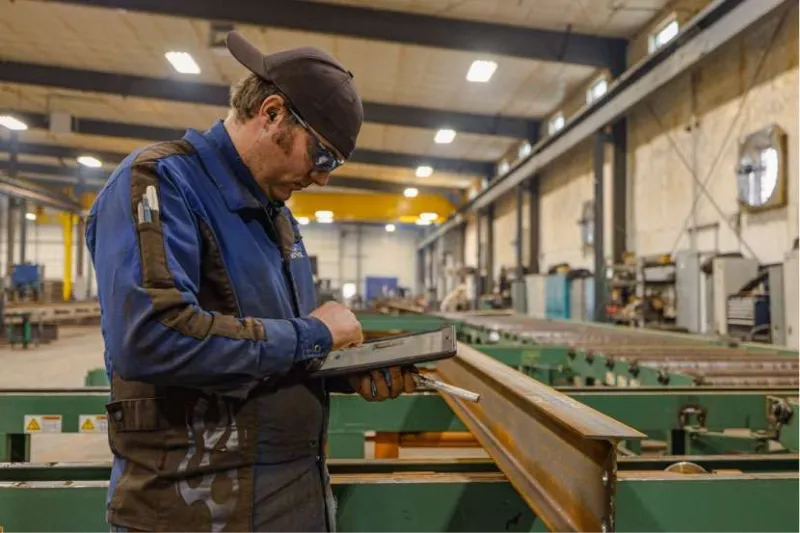
These shops bring capabilities that are difficult to replicate at scale overseas, particularly for low-to-medium volume custom work. Precision cutting, forming, welding, and finishing operations require skilled tradespeople whose expertise is built over years of hands-on work. American fabrication shops have invested heavily in CNC machining, laser cutting, robotic welding, and advanced quality inspection systems, enabling them to produce complex components with speed and consistency.
For companies reshoring production, these shops serve as critical partners rather than mere vendors. They collaborate with engineering teams during the design phase, offering design-for-manufacturability input that reduces cost and improves producibility. They maintain material inventories that allow for rapid order fulfillment. And they carry the certifications — AWS, ASME, AISC, and others — that demanding industries require.
Real-World Scenarios Where Reshoring Has Delivered Results
Consider the experience of a mid-sized industrial equipment manufacturer that had previously sourced structural steel weldments from a supplier in China. Lead times averaged fourteen weeks, and quality nonconformances were a recurring problem, requiring incoming inspection of every shipment. After transitioning to a domestic fabrication partner, lead times dropped to three weeks. Incoming inspection was replaced by supplier-certified documentation. And the engineering team was able to work directly with the fabrication shop to redesign several components, reducing material cost without sacrificing performance.
Or consider a construction equipment company that faced tariff exposure on steel fabrications sourced from overseas. The tariff burden, combined with rising freight costs, effectively eliminated the offshore cost advantage. Transitioning to a domestic fabrication source not only resolved the tariff issue but also allowed the company to market its products as American-made — a designation that carries meaningful value with certain buyers, particularly in the government and infrastructure sectors.
Supporting Local Economies While Competing Globally
Reshoring is not purely a strategic calculation. It also carries economic and civic dimensions that resonate with American manufacturers, their customers, and the communities in which they operate.
Domestic fabrication jobs are skilled, well-compensated positions. Welders, machinists, and fabricators earn wages that support middle-class livelihoods. When a manufacturer sources domestically, those wages circulate through local economies — spent at local businesses, generating tax revenue, and sustaining communities that were hollowed out by decades of offshoring.
Federal procurement programs, including Buy American provisions embedded in infrastructure legislation, create additional incentives for manufacturers to establish domestic supply chains. Companies that can demonstrate American content in their products gain access to government contracting opportunities that would otherwise be unavailable.
The Path Forward
Reshoring is not a sentiment. It is a business strategy, and like any strategy, it requires deliberate execution. Manufacturers considering a transition to domestic sourcing should begin with a rigorous total-cost analysis, engage prospective fabrication partners early in the process, and approach the transition as a relationship rather than a transaction.
Precision fabrication shops that have invested in modern equipment, skilled workforces, and quality systems are prepared to be genuine partners in that transition. The capability exists. The capacity is expanding. And the economic logic, for a growing number of manufacturers, is increasingly compelling.
America's manufacturing comeback is not a foregone conclusion. But it is a real and accelerating phenomenon — and the custom fabrication shops at its core are proving, one precision-built component at a time, that domestic production can compete on the world stage.