The Operator Behind the Output: How CNC Programming Expertise Defines Fabrication Excellence
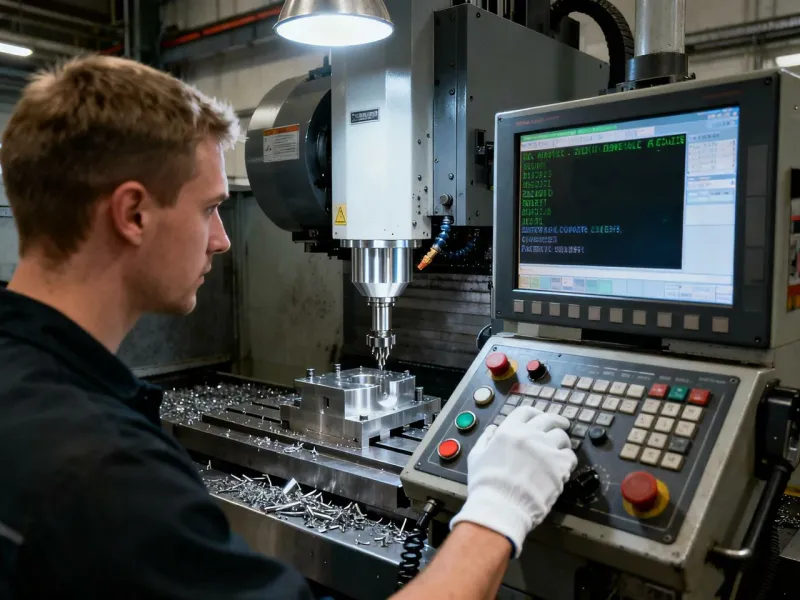
Photo: CNC machinist programmer reviewing code at computer workstation in metal fabrication shop, via www.uneedpm.com
The Machine Gets the Credit. The Programmer Does the Work.
Visit almost any fabrication shop in the country and you will likely hear the same pitch: a tour of the floor, a rundown of machine specifications, and a list of equipment brand names meant to signal capability. Five-axis machining centers. High-speed spindles. Automated tool changers. These are real assets, and they matter. But they do not tell the full story of what a shop can actually deliver.
The more consequential question—one that rarely gets asked during vendor evaluations—is who programs those machines, and how well.
In CNC fabrication, the quality of the finished part is not determined solely by the equipment producing it. It is shaped, in large measure, by the decisions made before a single cut begins: how the toolpath is structured, how the material is fixtured, how feeds and speeds are dialed in, and how the program is tested and refined before it runs on a production part. These are programming decisions. And they separate good fabrication shops from genuinely great ones.
What CNC Programming Actually Controls
To understand why programmer skill matters so profoundly, it helps to understand the scope of what programming governs.
A CNC program is not simply a set of movement instructions. It is a comprehensive operational plan for how a machine will interact with a workpiece. The programmer determines tool selection and sequencing, cutting depth and stepover values, approach and retract strategies, and the order in which features are machined. Each of these decisions carries consequences for part accuracy, surface finish, cycle time, and tool life.
A skilled programmer approaches a job with an engineer's mindset. When reviewing a part drawing or CAD model, they are already anticipating where deflection could introduce error, where a particular tool geometry will perform better than the obvious choice, and where a modified toolpath could reduce cycle time without compromising dimensional integrity. They understand not just how to make the machine move, but why certain movement strategies produce better results under real-world cutting conditions.
An inexperienced programmer, by contrast, may generate code that runs—but runs inefficiently. Cycle times stretch unnecessarily. Tool wear accelerates. Surface finishes fall short of specification. And in some cases, the part itself fails to meet tolerance requirements, triggering rework or scrap that erodes the cost advantage the shop was supposed to provide.
The ROI That Equipment Upgrades Cannot Replicate
Manufacturing leaders often face a familiar capital allocation debate: invest in new equipment or invest in workforce development. The instinct to prioritize equipment is understandable. Machines are tangible. Their specifications are quantifiable. Their acquisition can be depreciated on a balance sheet.
But the return on investing in experienced, continuously trained CNC programmers is frequently more durable—and more immediately impactful—than the return on equipment alone.
Consider cycle time reduction. A seasoned programmer reviewing an existing program will routinely identify opportunities to consolidate operations, reduce air-cutting time, and optimize tool engagement. These refinements do not require a machine upgrade. They require knowledge, attention, and experience. The result is faster throughput on existing equipment, which translates directly to improved capacity and lower per-part cost.
Consider first-article success rates. When a programmer fully understands the relationship between the machining strategy and the finished geometry, the probability of producing a conforming part on the first run increases substantially. Fewer iterations. Less material waste. Less technician time spent diagnosing why a feature is out of tolerance. These savings compound across every job the programmer touches.
And consider the downstream effect on tooling costs. Aggressive but uninformed cutting parameters accelerate tool wear and increase the frequency of tool replacement. A programmer who understands optimal chip load, heat management, and tool geometry selection extends tool life meaningfully—reducing consumable costs that, across a high-volume shop, represent a significant line item.
Setup Knowledge: The Underappreciated Half of the Equation
Programming skill does not exist in isolation. It is inseparable from setup knowledge—the ability to fixture a workpiece correctly, establish accurate work offsets, and anticipate how a part will behave during machining.
A programmer who has also spent time on the shop floor setting up jobs brings a perspective that purely theoretical training cannot replicate. They know which fixturing approaches introduce vibration, which part geometries are prone to movement under cutting forces, and how to design a program that accommodates real-world variables rather than assuming ideal conditions.
This integrated understanding—programming logic informed by hands-on setup experience—is one of the clearest differentiators between a shop that consistently hits tolerance and one that treats rework as a normal part of production.
What to Ask When Evaluating a Fabrication Partner
For manufacturers and procurement professionals selecting a fabrication partner, the evaluation framework should extend beyond equipment lists. A few targeted questions can reveal a great deal about a shop's true programming capability:
- How does your team approach toolpath strategy for complex geometries or tight-tolerance features?
- What is your process for verifying a new program before it runs on a production part?
- How do your programmers stay current with advances in CAM software and cutting tool technology?
- What is your typical first-article pass rate for new part numbers?
Shops with strong programming cultures will answer these questions with specificity and confidence. Shops that rely primarily on equipment reputation to carry the conversation may struggle to articulate what actually happens between receiving a drawing and delivering a finished part.
Human Expertise as the Enduring Competitive Advantage
The fabrication industry continues to advance rapidly. Machine capabilities expand. Software platforms grow more sophisticated. Automation reduces the labor content of many operations. But none of these developments have diminished the value of a skilled CNC programmer. If anything, they have amplified it.
More capable machines create more programming decisions to make well. More sophisticated CAM software requires operators who understand its full range of functionality—not just its default settings. And greater automation demands programmers who can design processes that run reliably without constant intervention.
At GSS Fabrication, the conviction that human expertise drives fabrication quality is not an abstract principle. It is reflected in how the team is built, how training is approached, and how every new job is prepared before it reaches the shop floor. The machines on this floor are tools. The programmers who operate them are the competitive advantage.
When you evaluate a fabrication partner, look past the equipment. Ask about the people behind it.