Closer to Home, Stronger by Design: Why Domestic Fabrication Shops Have Become America's Manufacturing Safety Net
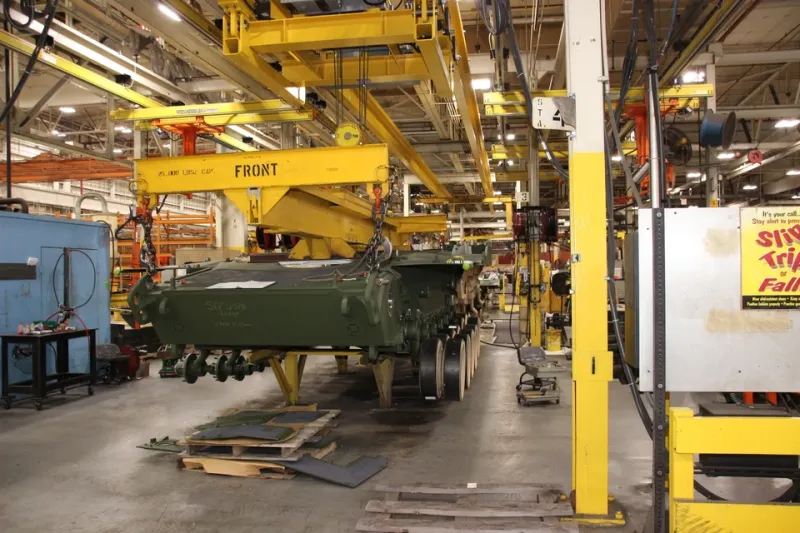
Photo: Brian Hahn, Public domain, via Wikimedia Commons
For the better part of three decades, the prevailing logic of global manufacturing was difficult to argue against. Offshore production offered labor cost advantages that domestic operations simply could not match, and the global logistics infrastructure—container shipping, just-in-time inventory systems, multinational supplier networks—made the distance feel manageable. American manufacturers optimized their supply chains for cost efficiency, and for a long time, that strategy delivered results.
Then the vulnerabilities became impossible to ignore.
Port congestion, pandemic-driven factory shutdowns, geopolitical tensions, and raw material shortages exposed a fundamental fragility in supply chains built almost entirely around the assumption that global logistics would function smoothly and predictably. Lead times that were once measured in weeks stretched into months. Components that had never caused concern suddenly became bottlenecks capable of halting entire production lines. The cost savings of offshore sourcing, when weighed against the cost of disrupted operations, began to look far less compelling.
What emerged from that reckoning was a renewed appreciation for something American manufacturers had been quietly undervaluing: the domestic fabrication shop.
The Reshoring Momentum Is Real and Accelerating
The reshoring movement is not a new phenomenon, but its pace has accelerated considerably in recent years. Data from the Reshoring Initiative, a nonprofit organization that tracks manufacturing job returns to the United States, has documented a sustained increase in reshoring announcements across multiple industrial sectors. Federal policy initiatives, including provisions within the CHIPS and Science Act and the Inflation Reduction Act, have reinforced this momentum by incentivizing domestic production in strategic industries.
For fabrication shops, this shift represents both a validation of their value proposition and a genuine surge in demand. Companies that once routed custom metal components through suppliers in Asia are increasingly turning to domestic fabricators—not merely as a contingency option, but as a primary sourcing strategy.
The reasons extend well beyond geopolitical risk aversion. When manufacturers calculate the true total cost of offshore sourcing—including extended lead times, inventory carrying costs, quality inspection overhead, freight expenses, and the cost of supply disruptions—the price differential between domestic and offshore production frequently narrows to a point where the advantages of proximity become decisive.
Proximity Is a Competitive Advantage, Not Just a Convenience
There is a tendency to frame domestic sourcing as a defensive posture—a way to reduce risk by accepting higher costs. That framing understates the affirmative competitive advantages that come with working alongside a domestic fabrication partner.
Consider lead time. A precision fabrication shop located within the continental United States can typically deliver components in days or weeks, not months. For manufacturers operating in fast-moving markets, the ability to respond quickly to design changes, accommodate urgent production runs, or adjust order volumes without committing to container-load minimums represents genuine strategic flexibility. That flexibility has measurable value—particularly in industries where product cycles are shortening and customer expectations for responsiveness are rising.
Communication is another underappreciated advantage. Working with a domestic fabricator means shared time zones, shared language, and the ability to engage directly with engineers and production personnel when specifications require clarification or when a design revision is needed mid-production. The friction costs of managing a supplier relationship across twelve time zones and a language barrier are real, and they accumulate in ways that rarely appear on a cost spreadsheet.
Quality Accountability in the Same Jurisdiction
Quality disputes with offshore suppliers are among the most frustrating challenges in global manufacturing. When a shipment of fabricated components arrives with dimensional nonconformances or weld defects, the remediation process—return shipping, replacement lead times, root cause investigation—can take months and impose costs that dwarf the original price savings.
Domestic fabrication shops operate within the same regulatory environment, quality standards framework, and legal jurisdiction as their customers. When quality issues arise—and in any production environment, they occasionally will—resolution is faster, accountability is clearer, and the path to corrective action is more direct. For industries where component quality carries safety implications, this jurisdictional proximity is not a minor consideration.
The Flexibility Premium Is Worth Paying
Critics of domestic sourcing often focus on unit cost comparisons that favor offshore production. That comparison is valid as far as it goes—but it does not go far enough. Unit cost is a static measurement that captures price at a single point in time under ideal conditions. It does not capture the cost of a production line halted by a missing component. It does not capture the cost of holding excess safety stock to buffer against unreliable lead times. And it does not capture the cost of missed market opportunities when supply constraints limit a manufacturer's ability to respond to customer demand.
Domestic fabrication shops offer something that offshore suppliers structurally cannot: the ability to pivot quickly. When a customer needs an order expedited, a design modified, or a production quantity adjusted, a local fabricator can respond in hours or days rather than weeks. That responsiveness has a dollar value, and in a manufacturing environment where agility is increasingly a source of competitive differentiation, it is a value worth paying a premium to secure.
A Strategic Partner, Not Just a Vendor
Perhaps the most significant shift in how American manufacturers are approaching domestic fabrication is the move away from transactional sourcing relationships toward genuine strategic partnerships. Rather than treating fabrication shops as interchangeable commodity suppliers, forward-thinking manufacturers are investing in deeper relationships with domestic partners—sharing demand forecasts, collaborating on design for manufacturability, and building the kind of mutual understanding that allows both parties to operate more efficiently over time.
That partnership orientation is well suited to the capabilities that strong domestic fabrication shops bring to the table. Experienced fabricators contribute engineering insight, material expertise, and process knowledge that can meaningfully improve a component's performance and producibility. When that expertise is engaged early in the design process rather than at the point of purchase order, the results consistently justify the collaboration.
The disruptions of recent years have been costly. But they have also clarified something important: supply chain resilience is not built through the lowest possible unit cost. It is built through relationships, proximity, and the kind of reliable, accountable partnership that domestic fabrication shops are uniquely positioned to provide.