One Part, Fifty Projects: How Disciplined Traceability Systems Keep Custom Fabrication Shops from Coming Apart at the Seams
Walk the floor of any busy custom fabrication shop on a Wednesday afternoon and you will likely find the same scene: steel blanks staged near a plasma table, a stack of partially finished weldments waiting on a cart, and somewhere in the middle of it all, a supervisor holding a part and quietly wondering which job it belongs to. This is not a failure of effort. It is a failure of system design.
Custom fabrication is fundamentally different from high-volume production. A production facility stamps the same bracket ten thousand times and ships them all to the same customer. A custom shop might be running forty active work orders simultaneously—each with its own material specification, tolerance requirement, finish callout, and delivery window. The parts often look identical to the untrained eye. The consequences of mixing them up are rarely identical at all.
Traceability in this environment is not a luxury. It is the operational backbone that separates shops that scale from shops that scramble.
Why Custom Fabrication Creates Unique Tracking Pressure
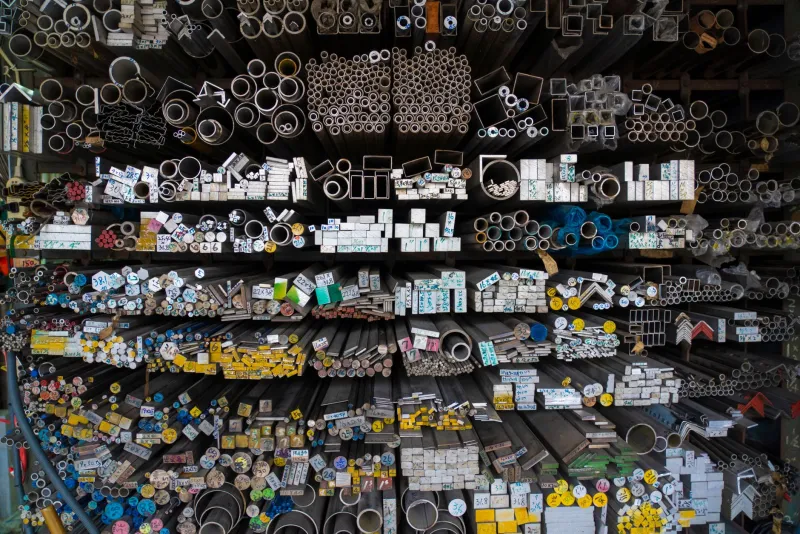
The traceability problem in custom work begins at receiving. A shipment of 304 stainless sheet may arrive and get staged in the same rack as last week's 316L order. Both are silver, both are flat, and both are destined for different customers with incompatible specifications. Without a system that tags material at the moment of receipt—and maintains that identity through every subsequent operation—the potential for a costly mix-up is introduced before a single cut is made.
The pressure compounds as work orders multiply. A shop running twenty concurrent jobs at any given time is managing twenty separate chains of custody for raw material, in-process components, and finished parts. Each chain has a different origin, a different destination, and a different tolerance for error. A bracket that ships to an agricultural equipment manufacturer may have entirely different finish and dimensional requirements than a visually similar bracket destined for a food processing facility. The drawing numbers are different. The stakes are different. The parts look the same on a cart.
This is the core challenge: custom fabrication shops are constantly managing objects that resist easy visual differentiation while serving customers whose requirements demand precise differentiation.
The Anatomy of a Traceability Breakdown
Most traceability failures in fabrication do not result from negligence. They result from informal systems that worked fine at lower volume and then quietly stopped working when the shop grew. A handwritten traveler that gets wet. A marker designation that smears during deburring. A verbal instruction about which stack of parts belongs to which job that gets lost between shifts. These are not dramatic failures. They are the ordinary friction points that accumulate until something ships wrong.
The downstream consequences, however, are rarely ordinary. A mislabeled part that reaches a customer's assembly line can trigger a production stoppage. A material mix-up discovered after final inspection may require complete re-fabrication. In industries where material certification is required—aerospace, pressure vessel work, certain structural applications—shipping an uncertifiable part in place of a certified one is not just a quality failure. It can carry regulatory and liability implications that extend well beyond the invoice value of the job.
Systems That Actually Work on the Shop Floor
Effective traceability in a custom fabrication environment does not require enterprise software with a six-figure implementation cost. It requires consistency, physical discipline, and a clear chain of identity from raw stock to finished shipment.
Material identification at receiving is the first control point. Every incoming shipment should be tagged with an internal identifier that links it to a purchase order, a material certification, and the specific work order or orders it supports. This tag should survive the shop environment—laminated paper, aluminum tags, or laser-etched metal discs depending on the operation. The tag travels with the material, not with the paperwork.
Job travelers remain one of the most reliable tools in a custom shop's traceability arsenal, provided they are treated as mandatory documents rather than optional reference sheets. A well-designed traveler captures every operation the part undergoes, who performed it, and when. It creates a timestamped record that supports both quality verification and post-delivery troubleshooting. Shops that digitize their travelers—using tablets or barcode scan stations at each workstation—gain the additional advantage of real-time job visibility without relying on anyone to physically return a paper document.
Part serialization becomes essential when a single work order contains multiple components that will be tracked individually through assembly or inspection. Serialization schemes do not need to be complex. A simple alphanumeric system tied to the work order number and a sequential part count is sufficient for most custom applications. What matters is that the serialization is applied early, maintained consistently, and referenced in the shipping documentation that accompanies the finished goods.
Staging discipline is the physical complement to documentation. Designated staging areas for each active work order—clearly marked, consistently enforced, and never used as overflow space for unrelated parts—prevent the most common form of mix-up: parts from different jobs commingling on a shared surface. Color-coded bins, labeled carts, and floor tape demarcation are inexpensive interventions that carry significant operational value.
Technology's Role in Modern Traceability
Barcode and QR code systems have become increasingly accessible for small and mid-size fabrication shops. A printed label applied at receiving can carry the full data payload of a work order—customer name, material spec, revision level, due date—and be scanned at each operation to update a central record. The barrier to entry for these systems has dropped considerably, and the operational return is immediate for shops running more than a handful of concurrent projects.
Some shops are beginning to explore RFID tagging for high-value or long-lead components, particularly in industries where chain-of-custody documentation is a contractual requirement. While the per-tag cost remains higher than printed labels, the ability to scan multiple parts simultaneously and maintain automated location records offers a meaningful efficiency gain in the right context.
The most important technology decision, however, is not which platform to use. It is ensuring that whatever system is chosen is actually used—by everyone, on every job, without exception. A sophisticated ERP system that operators route around because it adds friction is less valuable than a simple paper traveler that every technician actually completes.
Traceability as a Competitive Differentiator
Customers who place complex, high-stakes fabrication orders are increasingly asking about traceability before they award work. They want to know that if a problem surfaces six months after delivery, the shop can reconstruct exactly which material was used, who performed each operation, and what inspection results were recorded. Shops that can answer those questions confidently—and produce documentation to support the answer—occupy a different tier of supplier relationship than those that cannot.
For custom fabricators competing on quality and reliability rather than price alone, a mature traceability system is not overhead. It is evidence of operational competence, and it belongs in every customer conversation about what makes one shop worth more than the next.